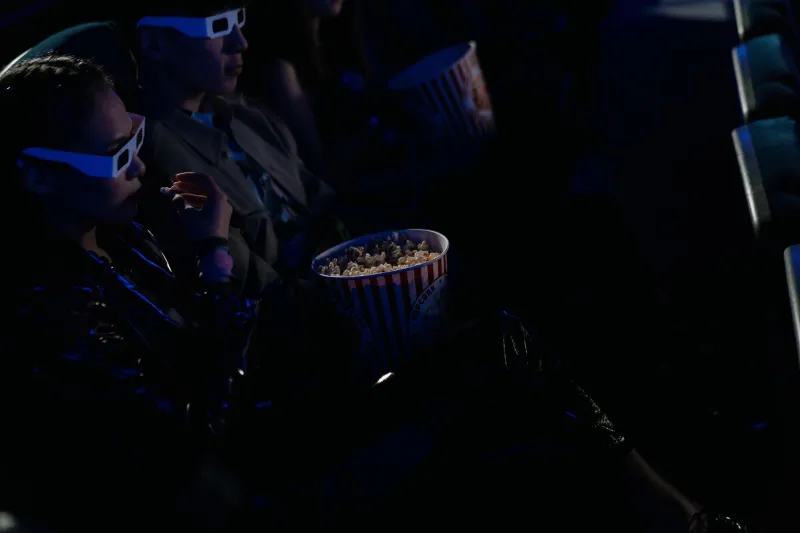
The Pumpkin Pie Detour: How Thanksgiving Weekend Became Indian Cinema’s Family Holiday in 2026
Photo: Radosław Botev, CC BY-SA 4.0, via Wikimedia Commons
Thanksgiving in a Desi American household rarely follows the brochure. There is turkey, sure, but there is also a tray of biryani someone insisted on making because cousins were driving in from out of state. There is pie, but there is also the question of who is willing to skip dessert to make the 10 p.m. show. And in 2026, that question is being asked in more US cities than ever.
The long Thanksgiving weekend has quietly become one of the most reliable moviegoing windows for Indian cinema in America. Not because families are abandoning the holiday, but because they are folding a film into it. A Thursday dinner stretches into a Friday outing. A house full of relatives needs somewhere to go that is not the living room. A big release, a nearby multiplex, and a showtime after the dishes are done suddenly look less like a plan and more like a tradition.
The Long Weekend Is the New Opening Night
Thanksgiving has a few things going for it that Diwali, for all its cultural weight, often does not. It always lands on a Thursday. It always creates a four-day weekend for many offices and schools. And it usually brings family members into the same zip code for a few days, which is exactly the kind of multi-generational audience that Indian films have learned to chase in the US.
Distributors have noticed. In 2026, several major Indian releases are being positioned around the Thanksgiving window with the kind of care that used to be reserved for summer or Diwali. That means staggered language-version rollouts, targeted screenings in suburbs with dense Desi populations, and showtimes that account for the fact that a family of eight is not going to make a 4 p.m. matinee after a heavy lunch.
The result is a weekend that feels less like a niche booking and more like a holiday corridor. Theaters in the Dallas suburbs, the Bay Area, New Jersey, Atlanta, and the Washington, DC, corridor are used to seeing Indian films do well. What is changing is the shape of the audience. It is not only young couples or college students. It is grandparents, teenagers, family friends, and the cousin who flew in from Seattle and has opinions about subtitles.
Dinner, Then Dolby
The 10 p.m. show has become its own character in this story. It is late enough to clear the table, early enough to get home before the leftovers become a midnight snack. It is also a showtime that fits the rhythm of a holiday gathering: people arrive in waves, parking takes longer than expected, and someone is always sent back to the car because they forgot the jacket.
For theaters, that means learning to staff a different kind of holiday crowd. Concession lines move slower when half the group is debating whether to get popcorn or just eat the food they brought in their hearts. Parking lots fill with minivans and rental cars. The lobby starts to look like a family reunion with a box office attached.
And then there is the food. Thanksgiving and biryani are not a natural pair on paper, but in practice they are a logical one. Both are built for a crowd. Both taste better the next day. Both give a family something to do with their hands while they argue about which showtime works best. The movie is the outing, but the meal is the reason everyone is together in the first place.
Why Thanksgiving Fits Indian Cinema Better Than Christmas
Christmas is still a big moviegoing season in the US, but it comes with its own set of obligations: travel, gifts, school breaks, and the general exhaustion of December. Thanksgiving is simpler. It is a food holiday with a long tail. Families are already together, already looking for a group activity, and already willing to stay out a little later than usual.
That makes it a natural fit for Indian cinema, which often runs long, often plays to mixed-age audiences, and often benefits from the kind of word-of-mouth that needs a few days to build. A Thanksgiving release can open on Thursday, pick up steam on Friday, and become the family default by Saturday. It does not need to be the biggest film in the country. It just needs to be the film that the cousins can agree on.
In 2026, that agreement is being made easier by better scheduling. Instead of dumping every language version into the same evening, distributors are spreading screenings across the weekend. Tamil and Telugu versions might dominate Friday, Hindi on Saturday, with subtitled shows tucked into earlier slots for families with younger kids or grandparents who prefer to be home before the roads get too dark.
The Theater as an Extension of the Dining Table
What makes this different from a standard holiday blockbuster is the way Indian films invite conversation. The drive home is part of the experience. Someone loved the comedy track. Someone else thought the second half dragged. A grandmother explains a cultural reference. A teenager explains a meme. The movie does not end when the credits roll; it ends when the last person gets dropped off.
That social texture is why Thanksgiving weekend works. It gives families a shared event that is not a meal and not a mall. It gives the holiday a second act. And for theaters, it offers a reminder that the Desi audience is not a monolith. It is families with different languages, different schedules, and different ideas about whether a 10 p.m. show is a good idea after two plates of food.
Theaters that get it right tend to do the small things well: clear signage for language versions, enough parking, and staff who understand that a long Indian film usually comes with an intermission. None of that is glamorous, but it is the difference between a family deciding to make the trip again next year and deciding to stay home with the leftovers.
A Holiday Ritual, Not a Replacement
Thanksgiving is not replacing Diwali in Desi American life. It is not supposed to. Diwali remains the cultural anchor of the fall, the festival that brings its own films, parties, and expectations. Thanksgiving is something else: an American holiday that Indian cinema has learned to borrow for a weekend. It is a practical fit, a family fit, and increasingly a box-office fit.
In 2026, that fit looks more intentional than accidental. The late show is on the schedule. The language versions are spaced out. The cousins know where to meet. And somewhere between the pumpkin pie and the biryani, a movie has become part of the holiday. Not the main event, maybe, but a ritual all the same.