From Sangeet to Last Call: The Film Songs That Still Run the Desi Wedding Floor
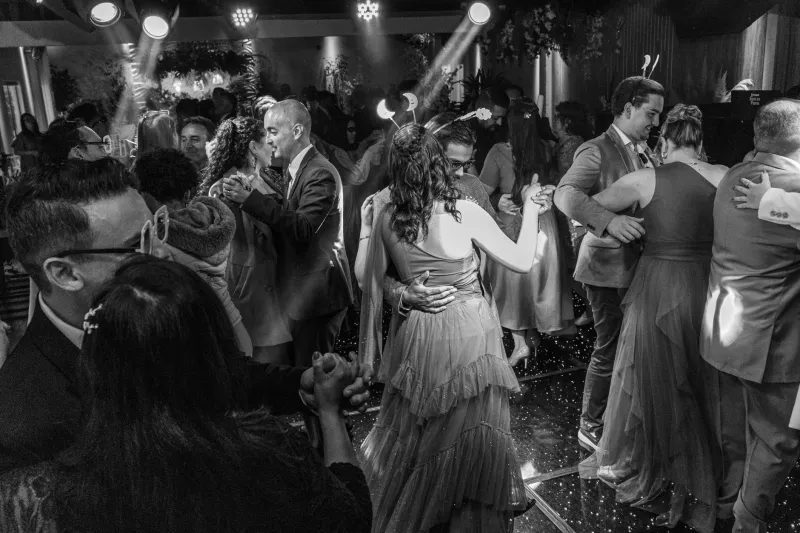
Ask a wedding DJ in Dallas what the hardest thirty seconds of the night are and you will get the same answer every time: the thirty seconds after dinner, before the floor fills. There is a specific song for that moment. There has been for decades. And the fact that everyone in the room — the aunt from Pune, the cousin from Sacramento, the college friend who has never seen a Hindi film — knows exactly which one is coming is the whole point.
Wedding dance floors are the last place in desi America where the entire film music catalogue still lives in one room, uncategorized by language, era, or algorithm. Nobody there cares whether a song is from 1995 or last month. They care whether it works. Here is what works.
The Opening Thirty Minutes Belong to the Aunties
No DJ in their right mind opens with a new track. The floor is cold, the aunties are seated, and the cousins are still in the parking lot taking photos. You need a song that requires no decision.
"Mehndi Laga Ke Rakhna" is the most reliable opener in the business — a thirty-year-old track that functions less like a song and more like a summons. "Bole Chudiyan" follows close behind, mostly because the choreography is baked into the culture; people do not learn those moves, they inherit them.
Choreographers who work the US circuit say the same thing about both: they are teaching tools. When a family hires someone for sangeet practice, the first rehearsal is always one of these two, because half the room already knows the steps and can carry the other half through.
The Standards That Refuse to Retire
Once the floor is warm, the setlist opens up, and it opens up along lines that have barely moved in a decade:
- "Gallan Goodiyaan" — the great equalizer. Big group choreography, a hook that survives bad speakers, and enough tempo changes to let people catch their breath without leaving the floor.
- "London Thumakda" — still the default for the cousins' group performance. It is short, it is funny, and it lets the least confident dancer in the family stand near the back and still look right.
- "Nachde Ne Saare" — the one that gets requested twice, and the DJ pretends not to have played it already.
- "Chammak Challo" — the crossover relic that somehow works on every demographic in the room, including the groom's college friends who know exactly one Hindi lyric.
The Cousin Takeover
Somewhere around the second hour, the aunties sit down and the floor changes hands. This is when the set goes faster, louder, and more Punjabi — "Kala Chashma," a bhangra block of "Proper Patola" and "3 Peg," and increasingly "Aaj Ki Raat," which has settled into the modern wedding canon faster than almost anything in recent memory.
DJs describe this stretch as tempo management more than taste-making. You are walking a crowd from roughly 100 beats per minute to something closer to 130 without anyone noticing they have been sprinting. The wrong song here does not clear the floor. It just lets it cool, and cooling is harder to fix than emptying.
What 2026 Is Actually Adding
The honest answer is: not much, and that is fine. Wedding rotation is conservative by design. A song has to survive roughly eighteen months of Instagram Reels, a sangeet season, and at least one viral hook-step challenge before a DJ will trust it with a peak slot.
This year's candidates are mostly coming from two directions. The first is the South Indian dance number — Telugu and Tamil tracks with big percussive drops that translate effortlessly to a banquet hall, partly because the hook steps are simpler and partly because the dubbed versions mean nobody in the room is hearing the song for the first time. The second is the Punjabi film track, which has effectively stopped needing a film at all; it arrives, it charts, it gets choreographed.
The practical rule most DJs use is the two-song test: a new track gets two plays, spaced at least forty minutes apart, in mid-tier slots. If the floor holds both times, it graduates. If it empties once, it goes back in the crate until next season.
Why These Songs Travel
There is actual craft behind which numbers survive the trip from screen to dance floor.
A wedding song needs a hook that a room can shout back on the second listen. It needs a tempo that sits comfortably between a walk and a sprint. It needs a choreography-friendly chorus — eight counts, ideally, with a gesture people can do while holding a plate. And it needs lyric familiarity that spans generations, which is why so many of the survivors are old enough to have been played at the parents' own weddings.
That last one is the real engine. Second-generation desi kids in the US frequently know the hook of a song and nothing else — not the verse, not the translation, sometimes not even the film. It does not matter. The hook is the passport. Nobody has ever been asked to leave a dance floor for not knowing the second verse.
The Slow Pivot and the Last Call
Every wedding has a moment where the DJ has to decide whether the night is ending or extending. The slow pivot — a few minutes of "Tum Hi Ho" or "Kesariya" — is less about romance than about resetting the room. It gives the older guests a reason to stay and the younger ones a reason to refill.
Then the closer. And the closer is almost always something with a shout in it, something where the whole floor ends up in a circle doing the same ridiculous thing at the same time. "Naatu Naatu" has earned a permanent spot here for exactly that reason — it is one of the few songs in the last decade that every single person at a US desi wedding, regardless of age or language or how much they care about Indian cinema, can perform without instruction.
That is the whole thesis, really. A wedding playlist is not a nostalgia exercise or a chart recap. It is a working compromise between three generations who do not share a first language, a film industry that releases hundreds of songs a year, and a DJ who has ninety minutes to get everyone in the same circle.
The songs that make it are the ones that require no translation. Which, for a diaspora crowd, is about as close to a native language as it gets.